

How Much Dry Cleaning For Great American Restauraunt
Adjustability is normally known as a key success factor in the dry-cleaning manufacture. As a result of its long history, widespread presence and many well-known environmental concerns, dry-cleaning professionals have grown accustom to inheriting demanding business practices that attach to ever-evolving industry standards.
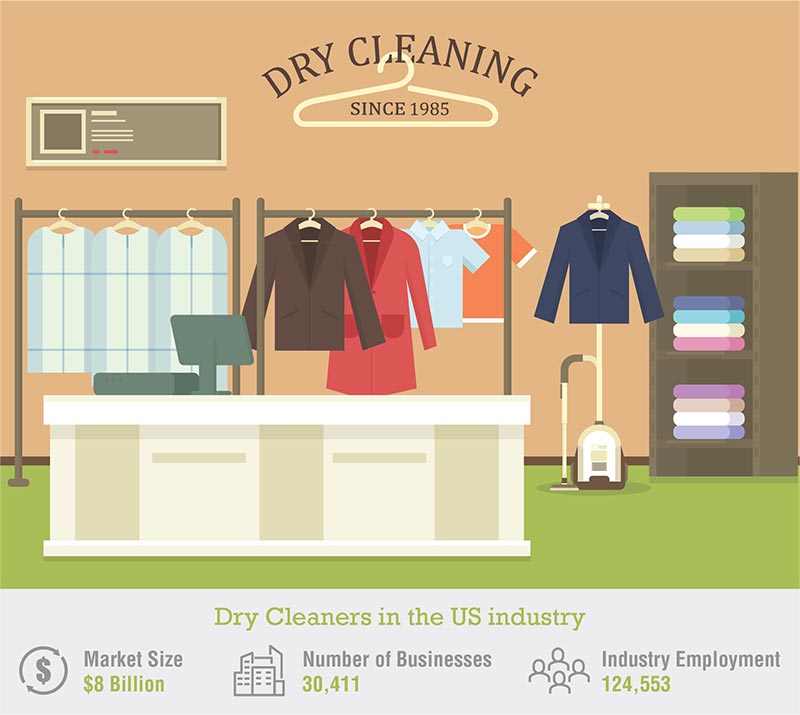
Although the dry-cleaning manufacture is highly fragmented and numerically in decline, it is still widespread beyond the United states of america and faces an increasingly stringent environmental regulatory burden.
Solvents – Background, Current Types
The outset dry-cleaning businesses reportedly started in Paris, France circa 1820 and in the U.S. circa 1840. Initially, the use of depression flash point, highly flammable, petroleum-based solvents led to well-nigh facilities being located outside of cities due to the increased fire hazard they posed. To reduce this hazard, the U.S. Department of Commerce required dry-cleaning solvents to have a minimum 100-degree wink point in 1928. This led to a rapid switch to Stoddard Solvent which met the new requirement. PCE, which is non-flammable, was reportedly first used in the industry in the early 1930s1. The perceived safety of PCE led to its rapid and widespread growth of usage throughout the manufacture.
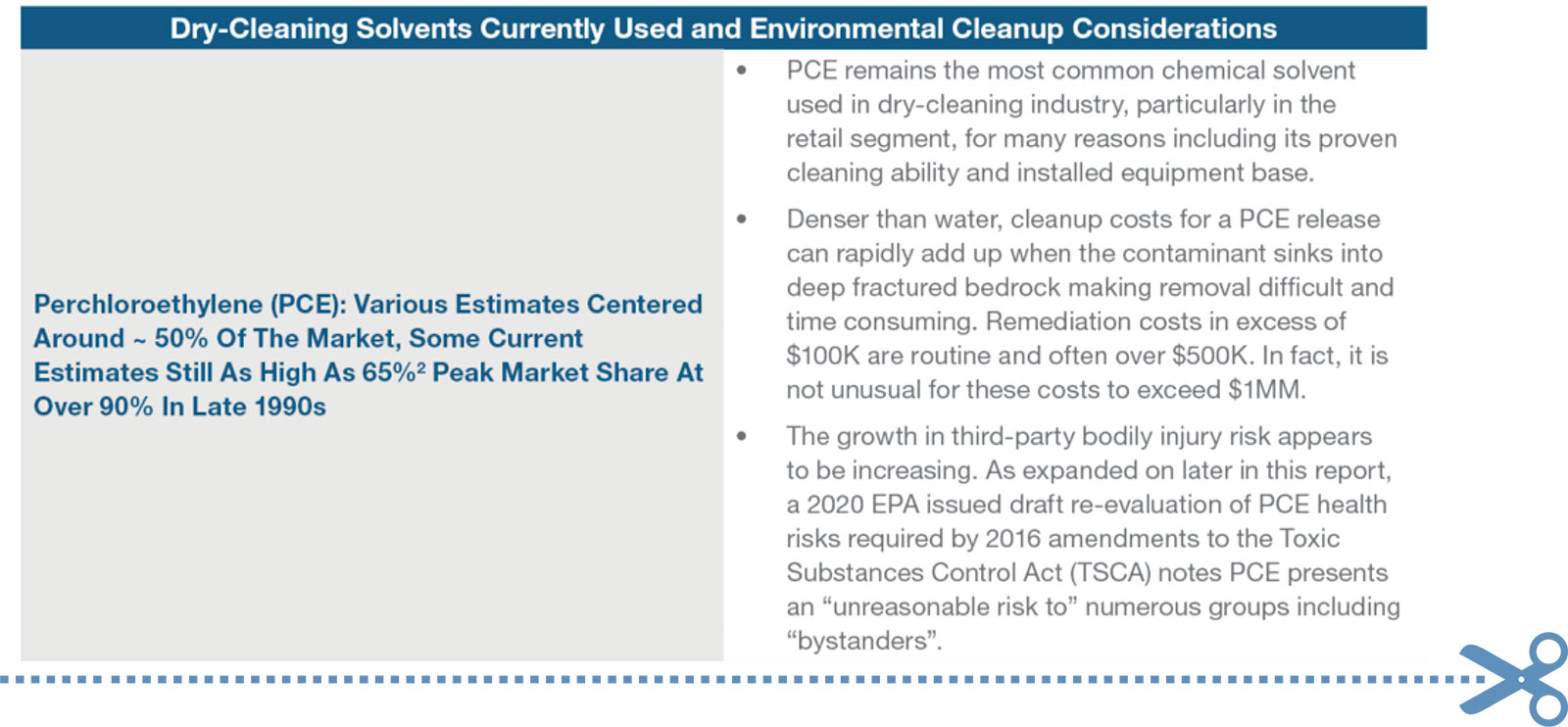
There are several boosted new solvents in apply including:
- Glycol ethers
- Rynex Holdings, LTD developed the solvent marketed as Rynex in 1995.
- Solveair (aka Solvair), a dual system of cleaning with Glycol Ether and extraction with liquid CO2.
- Impress, introduced by the Lyondell Chemic Company in 2004.
- DrySolv™ (n-propyl bromide) introduced past Enviro Tech International in 2006.
- Solvon K4 (dibutoxymethane) introduced by Kreussler in 2010.Solvon K4 is listed as a possible 'Unsafe Waste material' in Washington Countryiii.
- New, high flash-point synthetic petroleum solvents.
As the dry-cleaning market continues to evolve, New York has taken boosted regulatory precautions. Any dry-cleaner solvent used in New York must exist approved prior to utilize. Machines using but water or liquid carbon dioxide are non regulated. The NYS DEC website lists over a dozen state approved solvents other than PCE.
Some reliable old solvents reportedly still in use for isolated niche applications include:
- Benzene
- White gasoline
- Stoddard solvent
- Higher 140 wink solvents
Importantly, 'light-green' dry-cleaning has come to hateful any dry-cleaning process that does not employ PCE. As a effect, even petroleum-based dry out-cleaning solvents are ordinarily marketed as existence 'green'. Environmental considerations for the various new niche solvents have largely not been evaluated to date. Environmental considerations for the older existing solvents are expected to largely mimic those of the hydrocarbons group.
Industry Equipment
Industry Establishments
The dry-cleaning industry is highly fragmented with no single operator accounting for more than than 2.0% of industry revenue, and the elevation fifty industry operators estimated at less than 9.0%.
The manufacture has undergone significant restructuring over the by v years, with what were once-major companies downsizing considerably or exiting the industry altogether. U.s.a. Dry Cleaning Services Corporation, which owned more than 40 locations across the Country in 2018, is nearly nonexistent with stores shuttering without detect to customers or the community. Its website currently consists of a single webpage noting all locations are currently closed due to COVID-xix.
A challenge many industry entrants face up is increasing their market share. For this reason, we see a limited number of large or chain dry-cleaning companies and many smaller, mom and pop dry-cleaners.
"The barriers to entry into this space – to become up and running and start serving a scattering of customers – are pretty low. It'south the barriers to calibration that are incredibly high," Ajay Prakash, Co-founder and CEO of Rinse, said.
Industry Division
Dry-cleaning falls under NAICS 8123: "Drycleaning and Laundry Services" and more specifically as NAICS 812320.
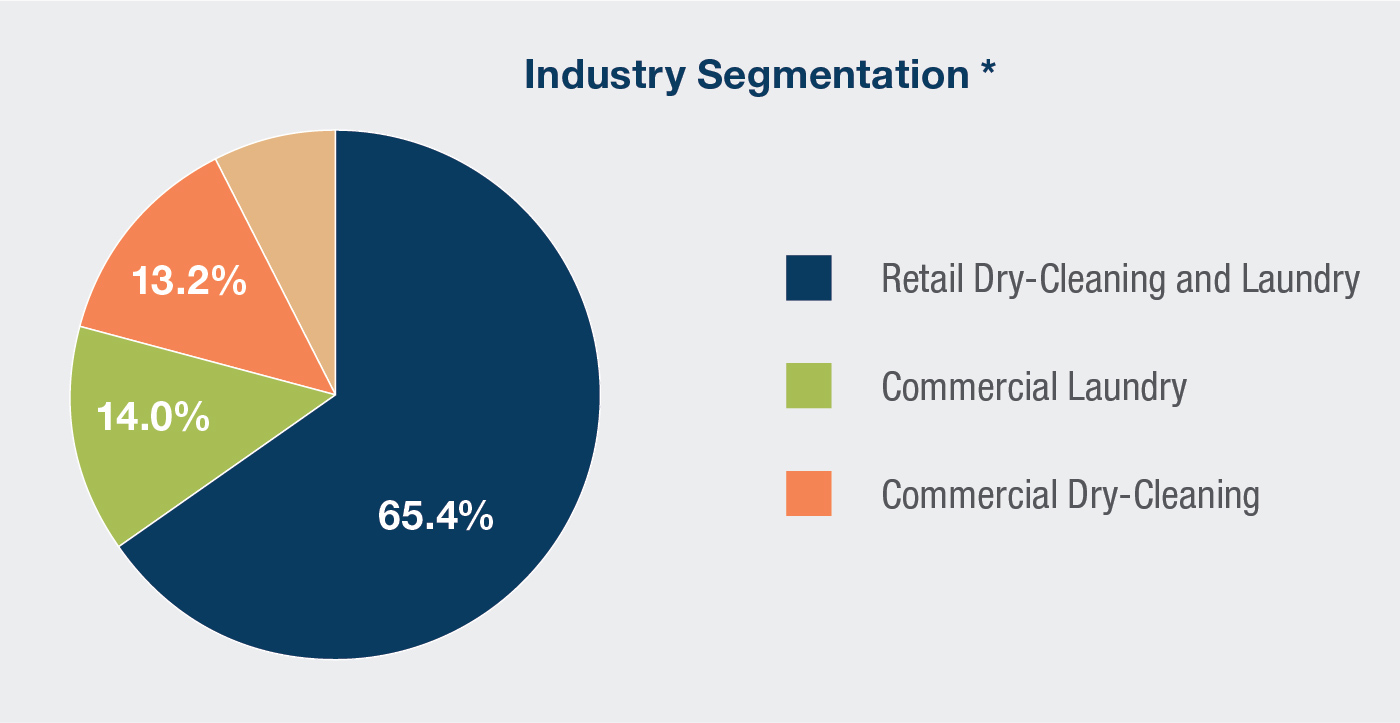
NAICS industry descriptions are divided into iii groups:
- Retail dry-cleaning and laundering services; includes drop-off and pick-upwardly sites and those offering specialty cleaning such as for furs, wedding gowns, draperies and more than
- Coin-operated laundry facilities
- Commercial companies that generate the bulk of its revenue from linen and uniform rentals
IBISWorld further segments the industry by breaking out commercial into laundry services and dry-cleaning services.
The largest commercial clients of full-service laundry are hospitals, restaurants, and hotels. Over the adjacent five years, hospitals are expected to experience robust demand because of rise per capita healthcare expenditure. Prior to COVID-19, demand from the hospitality industry was expected to similarly rise as the tendency of Americans dining out and taking domestic trips has risen. It is unclear how much the growth in each of these markets will drive corresponding growth in commercial dry-cleaning services versus laundry services.
Industry Key Trends and Stats
IBISWorld notes that the dry-cleaning industry displays the characteristics of an industry in the failing phase of its life bike. This indication supports the fact that the industry's small-scale contribution to the overall economic system is expected to go on a turn down at a projected annualized charge per unit of one.1%. Moreover, other indicators of the decline phase include falling employment, low profit margins, a consistent stream of enterprises exiting the industry and intensifying contest from substitute products and other industries.
Despite these negative trends, the manufacture remains highly competitive, localized and fragmented.
Manufacture Environmental Regulation
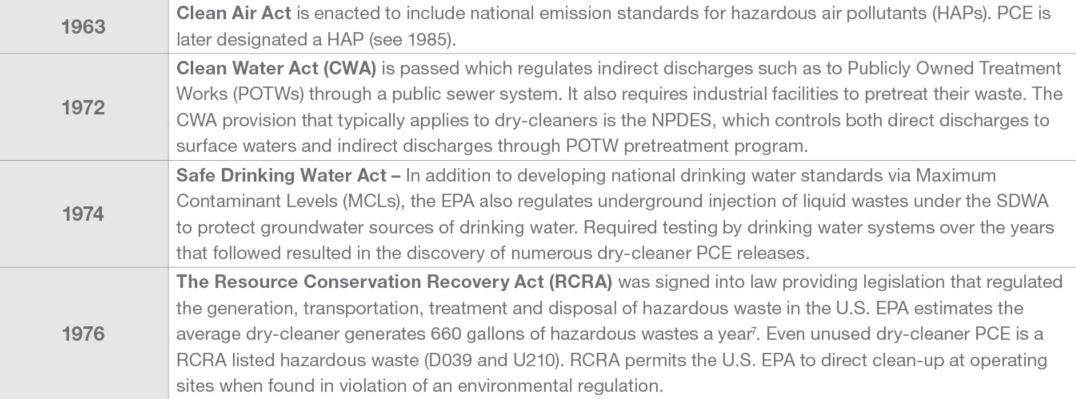
Continued tightening of ecology regulations, particularly in respect to use of PCE, will probable force many retail dry-cleaners out of the market, predominantly older single-shop facilities that still use PCE. A history of how diverse regulations impacted PCE use and more than broadly the dry-cleaning industry6 with increasingly stringent regulation follows:
2020 Implications
State Dry-Cleaner Funds
There are 13 States with formal dry-cleaner remediation programs for solvent release cleanup efforts.
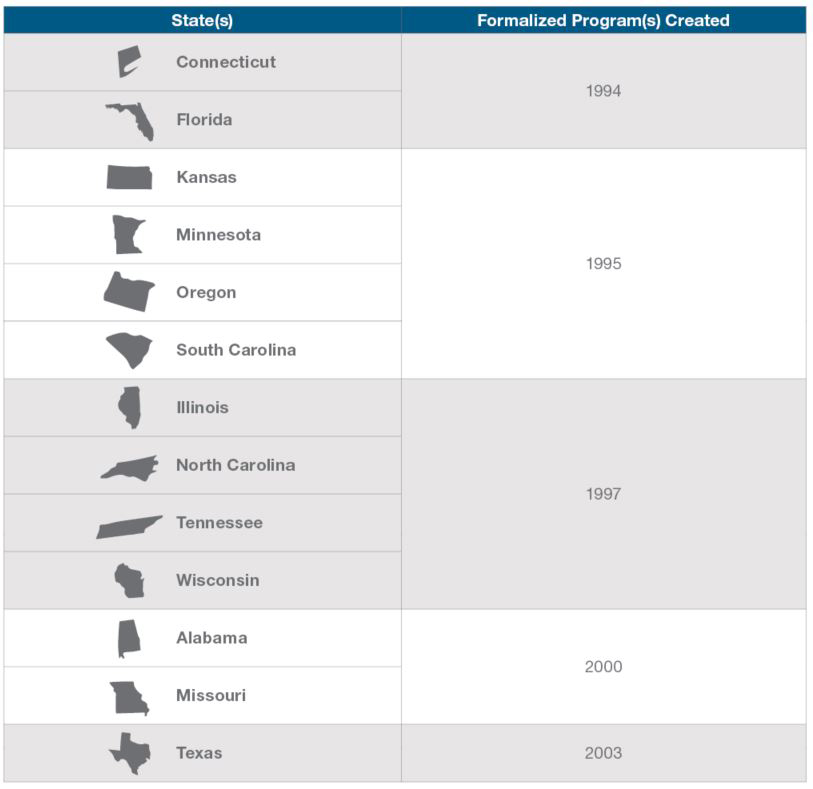
Environmental Protections
Every bit depicted above, the dry-cleaning industry is complex and presents many regulatory hurdles. As a professional working within the ecology insurance marketplace, it is important to partner with a knowledgeable carrier who can properly help mitigate the risks described higher up. Contact your underwriter today to larn more than about how our core products and services can assist protect your clients' dry-cleaning operations.
Paul Scian,Senior Loss Control Consultant, Technical Support
Cracking American Environmental Division
Paul is a Chance Analyst with Groovy American'south Environmental Segmentation. He brings over 30 years of ecology and insurance consulting feel to Great American. Paul's background includes hydrogeology and finance degrees with all-encompassing experience in greenfield, h2o supply development and brownfield redevelopment. He provides technical back up and training to our underwriters and is based out of our New York function.
References:
- https://www.cinet-online.com/historical-developments-in-cloth-cleaning/
- https://www.enviroforensics.com/blog/the-history-of-dry-cleaning-solvents-and-the-development-of-the-dry-cleaning-machine/
- https://issuu.com/greenearthcleaning/docs/solvon_k4_-_dangerous_waste_classif
- https://world wide web.inc.com/magazine/201804/bill-saporito/rinse-laundry-startup.html
- https://www.franchisechatter.com/2018/x/17/fdd-talk-2018-martinizing-dry out-cleaning-franchise-review-fiscal-functioning-assay-costs-fees-and-more/
- https://www.epa.gov/sites/production/files/2015-01/documents/dryclean.pdf
- https://www.environmental-constabulary.net/key-practice-areas/ecology-due-diligence/dry out-cleaners-and-commercial-real-manor/#:~:text=Studies%20by%20EPA%2C%20the%20State,500%20actively%20contaminated%20sites)%3B
- https://world wide web.sciencedirect.com/topics/earth-and-planetary-sciences/superfund-site#:~:text=More%20than%20600%20chemicals%20have,%25)%20(ATSDR%2C%201989)
- https://www.environmental-law.net/key-do-areas/environmental-due-diligence/dry-cleaners-and-commercial-real-estate/#:~:text=Studies%20by%20EPA%2C%20the%20State,500%20actively%20contaminated%20sites)%3B
- https://www.epa.gov/sites/production/files/2015-08/documents/scrd_10_year_report.pdf
- https://www.epa.gov/sites/production/files/2015-08/documents/scrd_10_year_report.pdf
- https://www.epa.gov/sites/product/files/2015-08/documents/scrd_10_year_report.pdf
- https://envnewsbits.info/2017/09/29/perc-dry-cleaners-co-located-in-residential-buildings-must-be-phased-out-by-2020/
- https://www.govinfo.gov/content/pkg/FR-2006-07-27/pdf/06-6447.pdf
- https://www.epa.gov/assessing-and-managing-chemicals-under-tsca/draft-hazard-evaluation-perchloroethylene.
- https://www.epa.gov/regulatory-information-sector/dry-cleaning-sector-naics-8123
- https://www.epa.gov/stationary-sources-air-pollution/petroleum-dry-cleaners-new-source-performance-standards-nsps
- https://www.broward.org/EnvironmentAndGrowth/EnvironmentalProgramsResources/Publications/Documents/DryCleaners.pdf

Source: https://www.greatamericaninsurancegroup.com/for-businesses/property-casualty-divisions/property-inland-marine/insights/features/environmental-evaluation-of-dry-cleaning-industry
Posted by: rollinsonews1937.blogspot.com
0 Response to "How Much Dry Cleaning For Great American Restauraunt"
Post a Comment