

What To Use To Clean Sludge Out Of Drain Pipes
 Foundation Drains
Footing Drains Prevent Foundation Leaks & Water Entry
- Mail service a QUESTION or COMMENT well-nigh foundation drains, ground drains, and perimeter drains used to keep h2o out of buildings
InspectAPedia tolerates no conflicts of interest. We have no human relationship with advertisers, products, or services discussed at this website.
Foundation drainage:
This article discusses building foundation drainage: footing drains, used to prevent foundation leaks and building water entry. This commodity series discusses types of drainage system south, including foundation drains or "french drains" for preventing wet basements and clamber spaces.
Nosotros likewise provide an Commodity INDEX for this topic, or you can try the folio top or bottom SEARCH BOX every bit a quick way to notice information you lot demand.
Foundation Drain Systems - Footing Drains
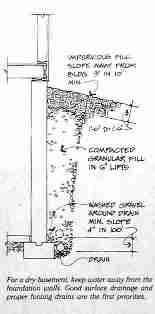
Our page top drawing of types of indoor foundation and basement drainage systems is provided courtesy of Carson Dunlop Associates.
[Click to overstate any image]
Commodity Series Contents
- FOOTING & FOUNDATION DRAINS
- DRAIN DEFINITIONS: FOOTING, FRENCH, PERIMETER Bleed
- FOOTING Drain INSTALLATION
- Basis Drain Bottleneck
- Ground Bleed BACKFILL DETAILS
- Ground DRAINS HOLES DOWN
- OVERLOADED FOUNDATION DRAINS
- FOUNDATION DRAINAGE FAQs
Definitions of a Footing Drain, French Drain, & Perimeter Bleed?
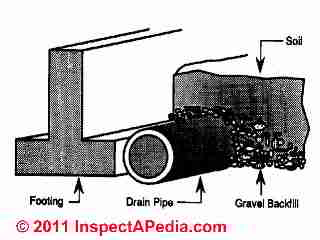
A basis drain, that is an exterior foundation drainage organization placed outside the foundation wall near the wall ground, at the level we show, covered with gravel, and if the footing drain going to exercise anything, it is piped to daylight or to a catch bowl that is in turn pumped to daylight or to a storm drain.
Well enough of people do call interior foundation drains or perimeter drains a "french drain". We don't.
A "French Bleed" is an outdoor buried drain line constructed to comport water away from the building, typically to a drywell or catch basin. Our sketch shows how we remove h2o from roof runoff that pours down a downspout.
Details most French Drains are
at FRENCH DRAINS for DOWNSPOUTS
Then what is the difference betwixt a french drain, a ground bleed, and a perimeter drain. A French drain is shown higher up, and a footing drain is shown in our two sketches below.
A perimeter drain is an indoor bleed cut into the floor around the perimeter of a basement or crawl space to intercept and remove h2o from the building interior. We illustrate perimeter drains above.
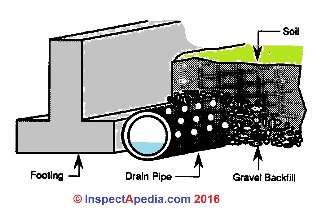
The drain shown in the sketch above is intended to describe an exterior foundation drainage organization. This drain is placed outside the foundation wall in the location shown, is sloped to bleed, and ideally drains downhill away from the building carrying h2o "to daylight".
Interior Trench & Drain
An interior trench and drain organisation is sometimes added inside a basement or crawl space that has a flooding trouble. If you imagine the bleed pipe shown to a higher place located on the interior of a foundation wall and then it'due south an internal perimeter drain.
Details about interior perimeter drain systems are
at PERIMETER Drain SYSTEMS
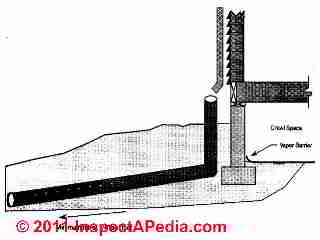
Lookout man out: the sketch above shows what tin be a common and serious mistake: connecting the roof drainage organization or downspouts or leaders into the ground drain system.
The result is likely to overload the footing drain or even if information technology doesn't practise then right away, eventually the footing drain clogs and the roof drainage ends upward in the building basement or crawl infinite.
If you take this bad organisation at your property you should consider a temporary above-ground extension to the downspout - don't go out it emptying into the foundation drain organisation.
Edifice Footing Bleed Details
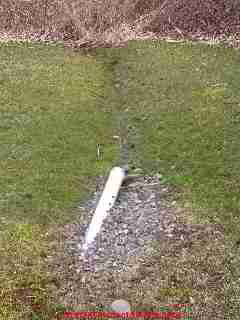
Find the cease of the footing drain system that used to drain to daylight (meet our photo below).
The foundation bleed organisation may have get buried with mud or covered past backfill. Clear any blockage at the end of the footing drain extension, open and bank check the finish for water flow in wet weather condition.
- Foundation drainage - drain tiles also chosen footing drains and by some folks "French drains" (which is not correct) water flows in the path of least resistance. Perforated 4-inch PVC or flexible ABS are the least costly and almost foolproof foundation drainage conduits.
Foundation drains should pitch at least 4 inches in every 100 feet of length.
The top of the foundation drain, should be below the top of the finished basement or clamber space slab. From the low corner of the edifice, the foundation bleed should continue to daylight or, if permitted past local codes, to a storm sewer, so that h2o will drain away from the building without relying on an electrical sump pump or other magic.
Come across FRENCH DRAINS for DOWNSPOUTS
- Footing drain hole perforations confront downwards: if you use perforated basis drain tiles that include perforations only on 1 side, face the holes downward. Water collects on the bottom. More details are
at Ground DRAINS HOLES DOWN
- Footing drains to a drywell? Some builders of homes on flat sites where drainage by gravity is not possible install a drywell to collect and store storm drainage from around a building.
Lookout man out: in areas of wet soils, in wet weather drywells are often not dry at all and may themselves fill-up with water from nearby soils, making this scheme simply non workable.
- Ground drains to a sump pit? I of our clients plagued with water entry at a flat site installed new foundation drains effectually her home, combined with an outdoor, frost-protected, duplexed, and battery backup sump pit system to pump foundation drainage to a nearby storm bleed.
Without the battery backup detail, this system might non accept worked: gauge when electrical power (for the sump pump) is most likely to fail?
Clogged Footing Drains
Even if foundation drainage was properly installed when a edifice was constructed, the system may no longer exist working. Over fourth dimension fine soil particles tin enter and clog the foundation drainage system.
If you know that a foundation drain system was installed - perhaps you tin find the end of information technology every bit nosotros illustrate above - and if the building foundation is leaking h2o from low on the foundation walls, and if piddling or no water is coming out of the end of the footing drain in wet weather, information technology'due south a good bet that the drain system has clogged.
Our photo (below left) shows the ground drain that was excavated and removed at the home of a client whose house suffered recurrent flooding. The erstwhile footing drain was totally impacted with mud.

The photograph below shows the ends of 3 new footing drains that were installed and carried to daylight. We remained a piddling nervous about just what the builder used for backfill - notice that silty mud coming out of the new drains? They may non have a long life.
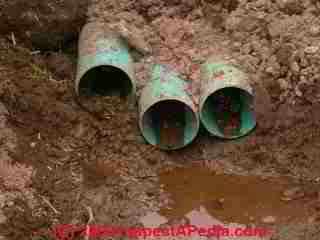
- Discover and un-clog the footing drains: excavate at a building corner, find the basis drains, cutting open up the drain to see how full information technology has go with silt, and have the drains cleaned using high pressure water or other methods.
- Reroute a non-working footing drain to a drywell if you lot can't become information technology to daylight
- Add missing foundation footing bleed sections that were omitted, such every bit around a chimney or building addition
Foundation Drainage Backfill Details to Prevent Basement H2o Leaks
- Bury the footing drains in gravel, both under and above the bleed tiles. Extend the gravel backfill at to the lowest degree two-thirds of the mode to the top of finished grade.
Gravel helps water period easily into the bleed system instead of seeking a mode into the building, and the removal of water exterior the foundation wall also avoids foundation collapse later.
The gravel size needs to be larger than the holes in the bleed tiles.
Our sketch (left) shows a less than optimum footing drain installation considering the artist placed soil likewise close to the bleed pipage.
- Footing drain geotextile covers: some builders also install constructed fabrics (geotextiles) over the basis drains before covering them to further slow the footing bleed bottleneck past dirt and silt.
Other builders place a layer of fifteen-pound building felt on top of the drainage bed to slow soil clogging of the gravel itself too every bit to protect the footing drains.
- Clay foundation bleed cap: the top human foot of backfill over the footing drains should be a depression-permeance clay cap to keep surface water (those spilling-over gutters) abroad from the foundation. If plantings are intended, add iv to 6" of loam on top of the clay cap.
Foundation Drain Perforated Pipe Holes "Up" versus "Holes "Down"?
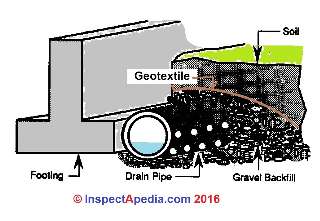
The foundation drain or "ground drain" I show in various illustrations to a higher place is a modification of the original page top drawing to illustrate water inside the drain pipe (blueish) and the placement of the pipe with perforations "upwards".
There is some statement amongst builders about whether or not the footing drain should go "holes-up" or "holes down".
The "Up" position is thought to reduce the rate of soil clogging but has the disadvantage that h2o outside the foundation has to ascension to the height of the holes to get into the drain. This isn't a terrible trouble for the common case that water is entering the footing drain by percolating down through soil from in a higher place.
Withal in my OPINION "holes down" and well bedded in gravel nether as well equally around and above the footing bleed pipe and with gravel covered by a geotextile is the optimum solution.
That means water finds its way into the basis bleed arrangement as soon as it reaches the level of the bottom of the footing bleed pipage - sooner than if information technology has to rising several inches higher to get into the drain line.
That reduces water pressure under and around the foundation basis and reduces chances of water entry into the structure.
Incidentally though I prove blue in the bottom of the footing bleed in the sketches above, yous should not normally see standing water in a ground drain. If you do the drain is
- Partly or fully clogged
- Not properly sloped down to daylight
- or is overloaded and inadequate to handle the volume of h2o entering the bleed organisation - y'all might run into this status of you lot examine the footing drain interior during very wet weather and during heavy rain.
Nosotros discuss the orientation of perforated drain line holes - up, downwards, or in-between, in more detail and in a unlike awarding
at SEPTIC TRENCH LINE SPECIFICATIONS.
There where we are worried most sewage sludge clogging the bleed system we put the perforated holes at v and 7 o-clock if we can, theorizing that we're deferring the bottleneck of the drain line exit holes by sewage sludge.
You lot could make the same argument about silt collecting inside the footing drains around a foundation.
Just for foundation drains around a foundation, I'thousand more worried nigh intercepting water as soon equally possible to keep it out of the edifice.
Overloaded Ground Drains
We explain at GUTTERS & DOWNSPOUTS that it's a bad thought to connect the roof drainage organisation to the building footing drains.
The added water book may overload the drain system leading to foundation leaks.
And worse, when later in the life of the edifice the foundation drains clog, we of a sudden brainstorm directing 100% of the roof runoff into a lake of water trapped around the building foundation - virtually guaranteeing that the basement floods.
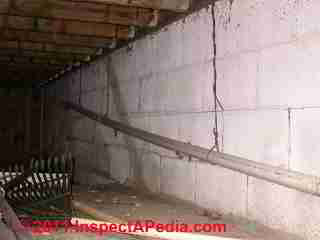
Our photos (below) show a habitation whose roof drainage system passed through the clamber space wall, across to the other finish of the building, exited the clamber space to go back exterior where it dove downwardly into the building basis drain organization. The outcome was a constant wet finished basement.
Discover in our second photograph (beneath correct) that a clue telling us the whole drainage system was chock-full and backing upwardly was that during pelting water leaked out of the tee at the top of the vertical drain line that was continued to the footing drains.
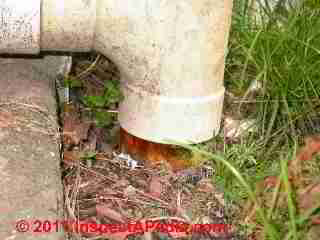
At a recently constructed home nosotros determined that the roof gutter system was continued to the foundation drains, and warned the buyer about the chances of basement flooding. The dwelling was 10 years old, and the basement, by every inside inspection indication, was "dry out".
Merely ii years later, post-obit a period of heavy rain the client chosen to exclaim "Geez, our basement is full of water!" IT was like throwing a switch. The footing drain outlet clogged and the basement but filled right upwards.
Here we include solar free energy, solar heating, solar hot water, and related building energy efficiency comeback articles reprinted/adapted/excerpted with permission from Solar Age Magazine - editor Steven Bliss.
Reader Q&A - as well meet the FAQs series linked-to below
George,
it sounds equally if the drainage ditch that you were relying on as too serious problems. The offset is that it'due south on your neighbor's property which is not A good that for you and might be objectionable to your neighbor.
The 2nd is that the ditch is being filled in which means that it's probably no longer accepting water. You're going to need to find another drainage destination
I connected my business firm foundation drainage to the farmer's field drainage system & my sump pump keeps running meaning it'southward non emptying through the field system. When the foundation drain emptied into a drainage ditch the sump would make full to the level of the intake then catamenia to the ditch & the sump pump would never run. It was similar that for near ix yrs & worked no affair how hard it rained
. I was careful to maintain proper slope to the connecting bespeak of the farm field organization and so practice not know why it'south not working. The ditch is on my neighbour's belongings & information technology was getting filled with droppings & I couldn't maintain it with the resultant consequence with my sump. Whatever advice?
Thank you for asking, Robin, but no; there's no color lawmaking that is specifically intended to distinguish between a foundation or footing drain and a downspout drain or extension.
When I've tested drain lines by putting water into them, such as running a hose into a gutter at the downspout to permit watching the end of that drain, when I do not see whatsoever outflow I don't necessarily assume that the non-flowing drain is a footing drain; instead, it could but exist a blocked downspout drain extension.
Sentry out: we never desire to connect a downspout drain into the footing drains - every bit some builders take done; the risk is overloading the footing drain and causing basement or crawl space water entry. When in dubiety about the downspout destination, I might at least temporarily remove the connection to the cached drain line and extend the downspout abroad from the building in a higher place grade.
In peculiarly troublesome drain troubleshooting cases information technology's worth running an inspection photographic camera through the drain line.
Are foundation drain pipes white in contrast to gutter drain pipes that are light bluish? I am trying to figure out what a white drain pipe is connected to. It is not connected to whatsoever downspouts then I am assuming information technology is a foundation bleed.
Reader field report: French Bleed System Failures & Installation Errors: Diagnosis & Repair
 ...
... 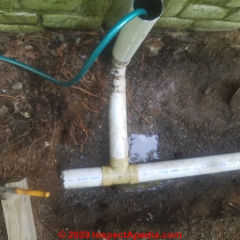
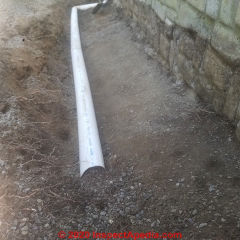
Perchance these two shots can aid illustrate key "how not to" considerations for French drains.
[Click to enlarge any image]
The original house (1950) was built directly on ledge with a stone-and-cobblestone foundation. The upper ledge is gneiss which comes with a lot of natural layering and seepage, while the lower part sits on granite which is nearly impervious.
The grade is not consistent, and so while the ledge slopes toward the business firm all the way down, the ledge dips lower in several places which naturally collect water at the foundation.
Some fourth dimension in the 1990s the previous owners must accept spent a packet of money putting in new gutter drainage and a French drain. They congenital a 3-5 pes-broad concrete berm/swale shaped onto the ledge and then ran 10' sections of perforated PVC two anxiety down the slope of the mini-swale (just non at the depression-point?!) and covered everything with xx yards or and so of fine gravel.
The issues with this foundation drain organization are:
 ...
... 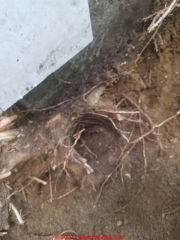
(1a) The upper 20' of perforated PVC sits as much equally a human foot above the lower counters of the swale/ledge, and so that big amounts of water must pool before whatever of it tin be carried away past the pipe.
(1b) The ledge is porous to brainstorm with and the seam with the concrete is fifty-fifty less of a barrier, and then the upshot of the pooled water is a 12 calendar month, 24/7 wet basement, regardless of climate or flavor.
(two) The "new" downspout joins the perforated PVC at a T-joint where the ledge slopes downwards on both sides, and then that any droppings at all in the lower pipage backs downspout water into the upper section of the perforated PVC, ensuring that the pooled water is constantly replenished and the cellar never dries out.
(3) Furthermore, the lower thirty+ feet of drainpipe - below the downspout - is (incorrectly) perforated as well, then that water gets released next to the firm all the manner downhill.
My plan is to dig out to the outer border of the cement swale forth its full 50+' length and endeavor to glaze the seam with the ledge with hydraulic cement or similar, then lay sleeved, perforated PVC cut in lengths to lay as apartment as possible to the depression points of swale and ledge while stil angling downhill.
I'll have to run a separate solid PVC line for the downspout, since the tree-roots and pino-needles pretty much guarantee a certain amount of crud in the pipe that could back up into any tied-in French bleed. (I wish I could sleeve a solid pipe inside the perforated four", but I don't call up it would have sufficient capacity.)
I'll exist happy to hear back if yous notice anything notoriously wrong with my plan, but all I really need to do here is go you the photos for Inspectapedia'due south splendid "rogues gallery"...- Anonymous by private email 2091/08/20
Additional Comments:
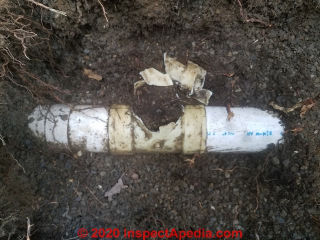 ...
... 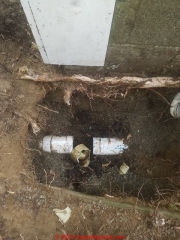
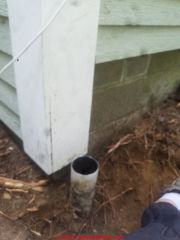
1] more than photos (beneath): I've dug out the bottom stop and uncovered further misdeeds. It'due south perforated PVC all the way downwards, and - every bit if that wasn't enough - the perforated pipe and then it makes a xc° plow and continues forth the downhill side of the house.
I'm still not sure where or if it has an outlet, but there's a suspicious persistent icy patch in the winter partway down the driveway...
The original PVC T-joint clearly degraded, just the super-wet lower corner was an obvious magnet for roots and they had infiltrated the arrangement from all over.
[two] Plan B for the set up:
The two gutter downspouts volition need new, solid lines to behave water abroad from the house.
Meanwhile, for the now-separated French drain, I'd notwithstanding like to do some sealing at the seam of the trench (best sealant?) so lay a 6-human foot width of landscaping fabric along the bottom of the trench with 8-perf flexible pipe resting directly on information technology. I'll backfill with as much of the old (washed) gravel equally volition fit and fold the extra landscaping fabric over it before backfilling with mixed gravel and dirt. (I'll haul off some of the excess, every bit information technology looks like the dirt will continue to build upward at a rate of 1 inch every 2-three years.)
As I've mentioned, however, the master drainage trouble is non from surface water next to the house (which will be fully guttered), but from h2o and seepage following the surface of the ledge from uphill, so I'grand not overly concerned with slow percolation from directly above.
I'll need to cap off the top cease of the remaining original drain where it continues by the downhill face of the house and run the "new" French drain drainage away from the business firm alongside the new downspout flow.
Moderator reply:
Thanks Anon - you're into an important project and a classic example of the difficulty of knowing what snafus someone buried before nosotros came along.
It'due south in our publish-queue - I'll ask you to look at the textile when it's ready.
What seam are we sealing at "the trench" ?
If yous're sealing physical and it's make clean and dry, there are some butyl caulks or sealants that attach and endure well, though gooey and sticky to work with.
I've likewise used polyurethane sealants - SEAL CRACKS in CONCRETE, HOW TO
and POLYURETHANE FOAM INJECTION Crevice REPAIRS
Your photos illustrate a classic problem with foundation drain organization failures: y'all can't run into exactly what went wrong until the organisation is dug-upwardly. You'd non fifty-fifty take been able to push button a sewer line camera through these cleaved, clogged footing drains - nearly a guarantee of basement or crawl space water entry.
Reader follow-up:
Yeah… I had to re-remember sealing that seam (between the physical swale and the ledge).
Because the concrete was poured right onto clean ledge, there was nowhere to employ expanding cement.
The tarry butyl route made sense only I wasn't sure I would take plenty time to clean (and dry out) earlier the next rain (plus the mosquitos were awful, even if they couldn't land for all the DEET I had on), so I but laid fabric along the low-point (all down the seam) with the flexible drain placed directly on top of that, and so wrapped the fabric over to make a sleeve with as much make clean gravel inside as would fit.
Backfilled with the sometime pea-gravel (probably 90% gravel, 10% dirt) and threw some other sheet of cloth over that, then covered the top with the dregs of the gravel pile (probably 60/40 gravel/dirt).
I'd shoveled as much as I could of the first viii" of original dirt and roots to the side and then I'll movement that somewhere else, since (a) there's not plenty r-value to exist gained by cyberbanking it confronting the foundation and (b) more dirt's going to build up over the years anyway.
I notwithstanding need to do something with the water at the low finish of the French drain, then once the lower downspout'due south in place at that place'll be a new trench to carry both drains straight downhill side-past-side.
I haven't been very consistent at documenting all the lessons-learned on this project, just at some point I'll dig effectually for some other stuff that may charm you lot. Some of the best textile was from the original house here that burned in 2016: information technology had been a deluxe 1950 three-bedroom ranch that had a second flooring added over the original footprint 5 years later - and at the same time they added a 6-foot bump-out to the first.
The simply continuous vertical supports so were the new stairwell, a post in the living-room and the chase for the extended chimney. The last things keeping the 5-pitch roof from pancaking were the joists in the second-flooring ceiling…built of lapped 2x3s. Every bit you tin imagine, the demolition was remarkably easy and fast.
Proficient point........how nigh only going below surface level? Apparently the h2o saturation comes from base but thinking of eliminating some extra h2o coming off the siding on that side of the house and potentially helping fight soil saturation. I did put in french drains at both corner downspouts which reroutes water away from the foundation. They extend about 10 feet out.
Bill
Perchance, just a worry is that digging part way down mat make the water entry worse by agonizing the soil. I would only try that if i thought the water source was at thst depth.
ps.... I know you probably shouldn't patch a cove articulation but considering it is then small-scale....only 2 feet or and so....should I patch a 4 or five human foot length with some hydrolic cement in addition to the exterior work? Only a thought? I know the hydrostatic force per unit area volition nonetheless exist just hopefully some of it volition be reduced?
Have plenty of time with "stay at home" orders and don't desire to utilise upwards all the economical stimulus coin with major foundation expenses. ;)
Any thoughts? Thank you in advance.
I take a cove articulation leak that extends about 2ft. long in the basement on the side of the house. Information technology only leaks about one time or twice a year and only afterward a really major rainfall. That foundation wall is about 10' deep and I do not wish to dig that deep to put in a footing drain. At that place are no downspouts close to it.
Can I simply dig about 3 feet deep along the foundation and put in some bleed pipe to divert water away from the side wall to help relieve footing saturation and force per unit area? The grade is excellent with the back of the house being three stories and the front being two stories. Not the perfect solution simply is it a patchwork solution? What do you think? Could salve thousands. Thanks.
Robert
Yous might want to dig up and explore the footing drains at a couple of spots to be certain the bleed is properly located, bedded in and covered past gravel; so wait at the outlet of the footing drain organization; if the diameter of h2o flowing out of the bleed is close to the pipe diameter and so the bleed is overloaded; I have run into this at wet sites; nosotros had to double the basis drain piping to handle the water volume.
To analyze the previous comments:
The footing ditch tapered from 2" below lesser of footer to 4.v" below bottom of footer at end of perforated pipe.
Over a 24 feet span dug done 2" below bottom of footer and at the point of 24 feet away dug downwardly iv.5" below lesser of footer. Installed 24 feet of perforated pipe connecting to solid pipe to drain water away from 24 anxiety of foundation. Yet water is seeping nether foundation???
Linda
What'south a "pop-up" and how does that handle drainage?
And yes, if the water outlet drain opening is above the level of water in the crawl area then water won't leave the clamber area through that opening except that portion of the h2o that rises above the bottom of the drain.
The hole through the block at the bottom of the foundation wall ought non harm the foundation structural properties.
I commend the contractor for trying to drain the clamber area by gravity, but this sounds like a faux drain. You lot might need a sump pump
Use the Article INDEX to run across our articles on CRAWL SPACE DRYOUT and yous'll see other steps that would be helpful.
To drain sitting water in a corner of my crawlspace , a contractor bore a pigsty thru the cinderblock and pushed thru a four inch french bleed to the outside. He sealed the hole with a cream product.
The water is supposed to drain out to the years and out a pop up.
It seems to me that the bleed inside is upwardly higher than the elevation of the standing water and will be useless. As well will this crusade deterioration of the foundation? should it be sealed with a masonry production?
Foundation drains typically run to daylight, and depending on the shape of the site, there might be one corner or a pair of corners from which drains leave the edifice - or even more locations depending, over again, on the building's footprint and on just how the site slopes away from the edifice.
And it'southward no surprise that between 1973 and recent years a foundation drain would clog. Unfortunately in my feel, even if you could get into the drain to try to clean the pipage, soil will re-fill the line.
However earlier digging up the whole foundation drain organisation to replace information technology, I would concentrate on a very thorough, careful inspection of the roof drainage arrangement and surface runoff details, as most of the fourth dimension that's where a building's water problems originate.
Cheers for building this page. I accept a 1973 carve up foyer home virtually 46' W ten 24' D. Effectually 1993 I added a 10'x20' rear deck and a eight'x10' front deck. Most ten years agone, I directed the downspouts through iv" PVC piping 100' to the garden in the backyard which is graded downhill abroad from the firm.
Most 5 years ago, I noticed h2o buildup under my rear deck which is built over the old patio space at the rear of the house on the lowest betoken near the abode - in that location is a sliding patio door at that place. This spot, right in forepart of the door gathers rainwater in heavy rains, no matter the duration of the downpour.
Previuosly, this area would not accumulate water. I take a spot, near this area where the foundation drain is visible - it is the flexible blackness plastic piping that appears to be about six" -viii". I'yard not sure where the 'daylight' end is only will look around or simply follow the section I see until I notice it unless you lot accept a better way to locate it. I'g thinking my bleed has broken down or become clogged over the years.
The front portion of the house hangs over virtually ii" so the upstairs dimensions are deeper than the downstairs. Since I'm only trying to effigy out the daylight, could there be multiple points of get out? I have a two car garage and driveway at the forepart of the firm with a large drain directly in front of the garage which provide the everyman point for daylight for the front end, and as I stated the back has the patio area, only further out in the yard is likely, simply I don't recollect ever seeing whatsoever place out there that water could be exiting from. The front end yard to the drainage ditch goes slightly upwards loma, then I'k guessing the builder did not attempt to drain there.
I'm guessing that I may need to supersede sections or the bleed entirely. so I'm thinking if I demand to replace it, I can excavate the onetime drain out, dig a little deeper, equally y'all say, a few inches away from the footer noting the weight bearing at a 45 degree angle equally you lot go down, add the geotextile, gravel, pipage, gravel, geotextile, existence sure to slope information technology so there is no continuing water at any bespeak.
And so , when I backfill, I read to tamp the ground for every 6"" of depth every bit I make full it to minimize futurity settling and particulate carryover into the drain. Am I missing anything? I like your idea of a professional person inspection and volition definitely have someone assess it locally.
how can we drain footing water
My home has a footing drain that runs to daylight simply appears to be running upwards hill! I never run across any prove of water running out of the drain... Should I exist worried?
Can I install a French bleed forth side a footing without compromising the footing?
Dania,
To protect reader confidence in our published fabric, InspectApedia does not sell services nor products.
Hi There,
I am looking for quote for reasonable foundation drains in my backyards.
please contact u.s. at 905-319-2087.
Greg, the sketches above bear witness that experienced installers place the footing drains at the level of the bottom of the footing, on and covered by gravel and a soil filter. I may non understand your question. Merely if you mean that the level of the crawl space is below the footings, that sounds similar a risky pattern - unsupported footings, and inviting water entry.
Should french drains go below the footing on a house with a raised foundation with a crawl infinite
...
Continue reading at BASEMENT WATERPROOFING - topic home, or select a topic from the closely-related manufactures below, or see the consummate ARTICLE INDEX.
Or run across FOUNDATION DRAINAGE FAQs questions & answers about foundation drainage systems posted originally at the end of this folio.
Or encounter
- BASEMENT WATERPROOFING - topic abode
- GRADING, DRAINAGE & SITE WORK for a description of outside surface grading and runoff control
Suggested citation for this web page
Ground & FOUNDATION DRAINS at InspectApedia.com - online encyclopedia of building & ecology inspection, testing, diagnosis, repair, & problem prevention communication.
Or see this
INDEX to RELATED ARTICLES: Article Alphabetize to Edifice LEAKS & WATER ENTRY
Or use the SEARCH BOX found below to Ask a Question or Search InspectApedia
...
Ask a Question or Search InspectApedia
Questions & answers or comments well-nigh foundation drains, footing drains, and perimeter drains used to keep water out of buildings.
Try the search box simply below, or if you prefer, mail a question or comment in the Comments box below and we will answer promptly.
Search the InspectApedia website
Note: advent of your Comment below may be delayed: if your comment contains an image, web link, or text that looks to the software as if it might be a web link, your posting will appear subsequently it has been canonical past a moderator. Apologies for the filibuster.
Technical Reviewers & References
Click to Testify or Hibernate Citations & References
Publisher InspectApedia.com - Daniel Friedman

Source: https://inspectapedia.com/Wet_Basements/Foundation_Drain_Specifications.php
Posted by: rollinsonews1937.blogspot.com
0 Response to "What To Use To Clean Sludge Out Of Drain Pipes"
Post a Comment